

The latest on the Karen Read murder case
Sign up for our Extra newsletter to get updates from the retrial and other breaking news alerts delivered to your inbox.
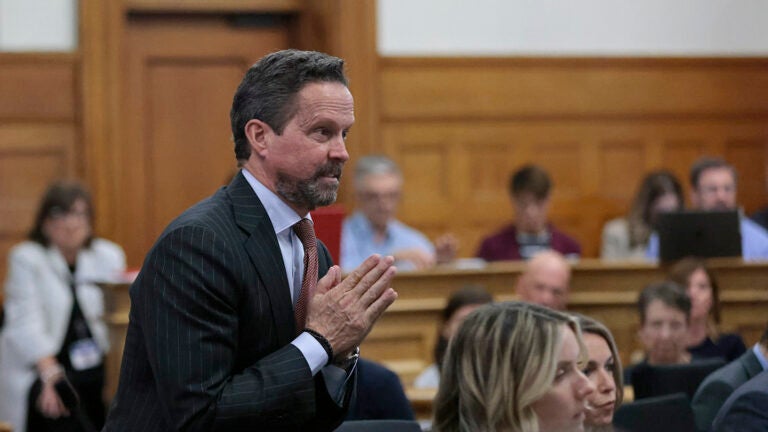
On the stand Monday:
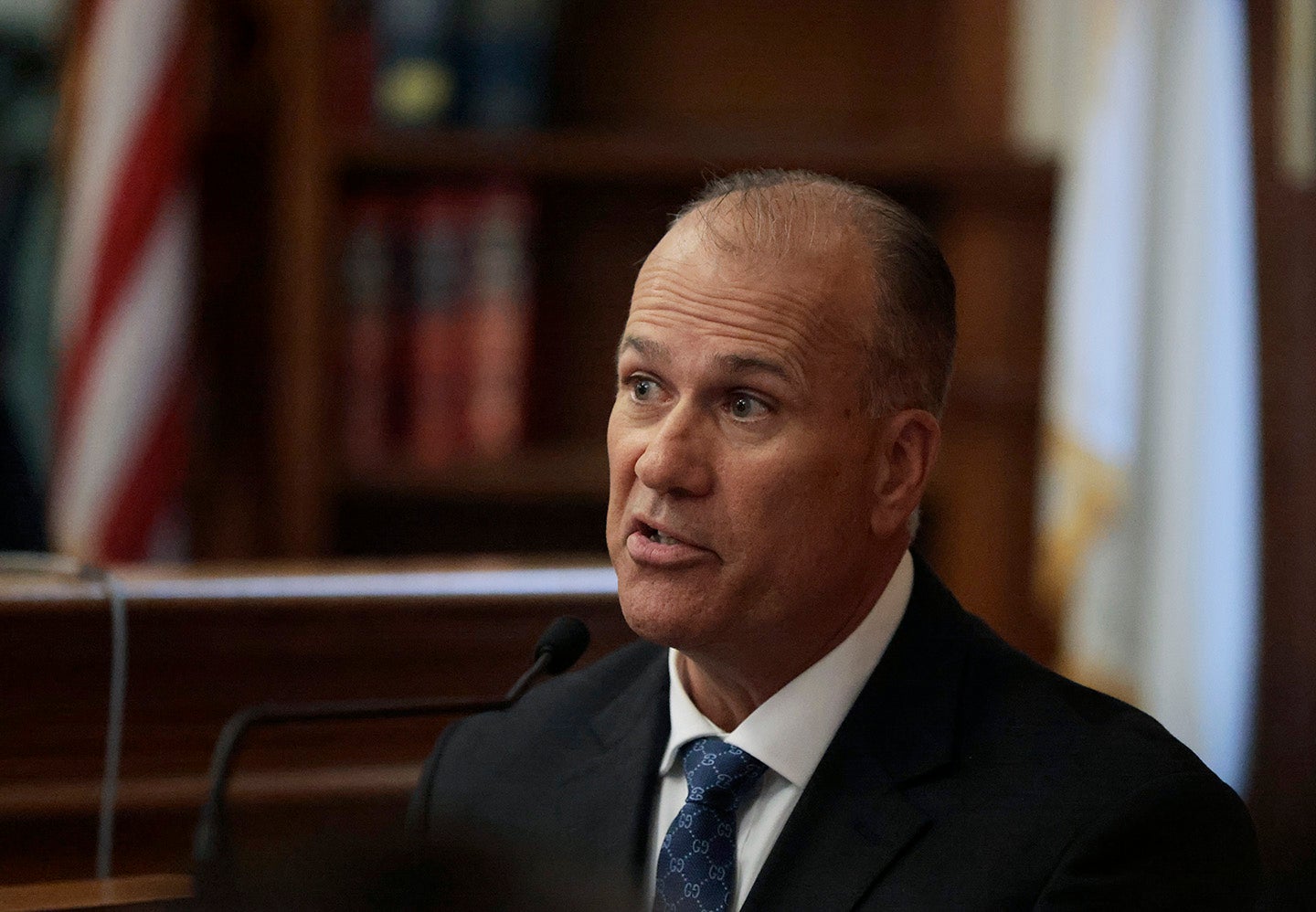
Searching for evidence after John O’Keefe was rushed to Good Samaritan Medical Center on Jan. 29, 2022, Canton police used a leaf blower to clear away snow and collected several blood samples in red Solo cups borrowed from a neighboring cop, retired police Lt. Paul Gallagher testified.
The highest ranking officer at the scene outside 34 Fairview Road, Gallagher recalled the conditions were “terrible” shortly after 6 a.m. on the 29th. The ground was frozen and covered in about 4 inches of snow, with more falling rapidly, he explained.
“It was your typical New England blizzard, basically,” Gallagher testified.
He recalled seeing spots of pink in the snow near where O’Keefe’s body had lain and said he thought they might be coagulated blood. Fearing that a shovel could break or miss evidence in the snow, he decided to send for a leaf blower.
“I wasn’t going to miss anything with a leaf blower,” Gallagher said. “Much better control.”
He told jurors he packed a tent as he set out for Fairview Road the morning of the 29th, wanting something he could use to cover a body in the event the call turned out to be an unattended death. But according to Gallagher, there was ultimately no point in using the tent, given the high winds. He noted the crime scene tape officers erected at the scene was “blowing wildly” in the wind and didn’t seem to be helping much.
Gallagher described poor visibility at the scene and said the house at 34 Fairview Road appeared dark. He noted Canton Police Sgt. Sean Goode and Lt. Michael Lank both entered 34 Fairview Road before he arrived, though no civilians exited any of the surrounding homes.
He testified that he decided to process the area where O’Keefe was found when Massachusetts State Police didn’t immediately respond.
“I think we had a duty and obligation to check around where he was found and see if there was any explanation to what caused this medical condition,” Gallagher explained, noting he had Goode video the excavation process.
He told jurors the pink spots in the snow became darker as he used the leaf blower to whisk away snow, and he decided to collect the apparent blood drops out of an abundance of caution. To contain the six blood samples, Gallagher testified he obtained red Solo cups from Deputy Police Chief Thomas Keleher, who lived in a neighboring home.
Special prosecutor Hank Brennan played video clips of Canton police using the leaf blower at a low speed to shift the snow, and Gallagher said some of the footprints visible in the video were from first responders or witnesses. He also pointed out a patch of what appeared to be bare ground in the area where O’Keefe’s body had been.
“Did the side yard have any footprints or evidence that anything was dragged through the side yard?” Brennan asked.
“No, not at all,” Gallagher replied.
“How about the front yard? Did the front yard have any evidence that anybody had walked across it or dragged anything across it?” Brennan continued.
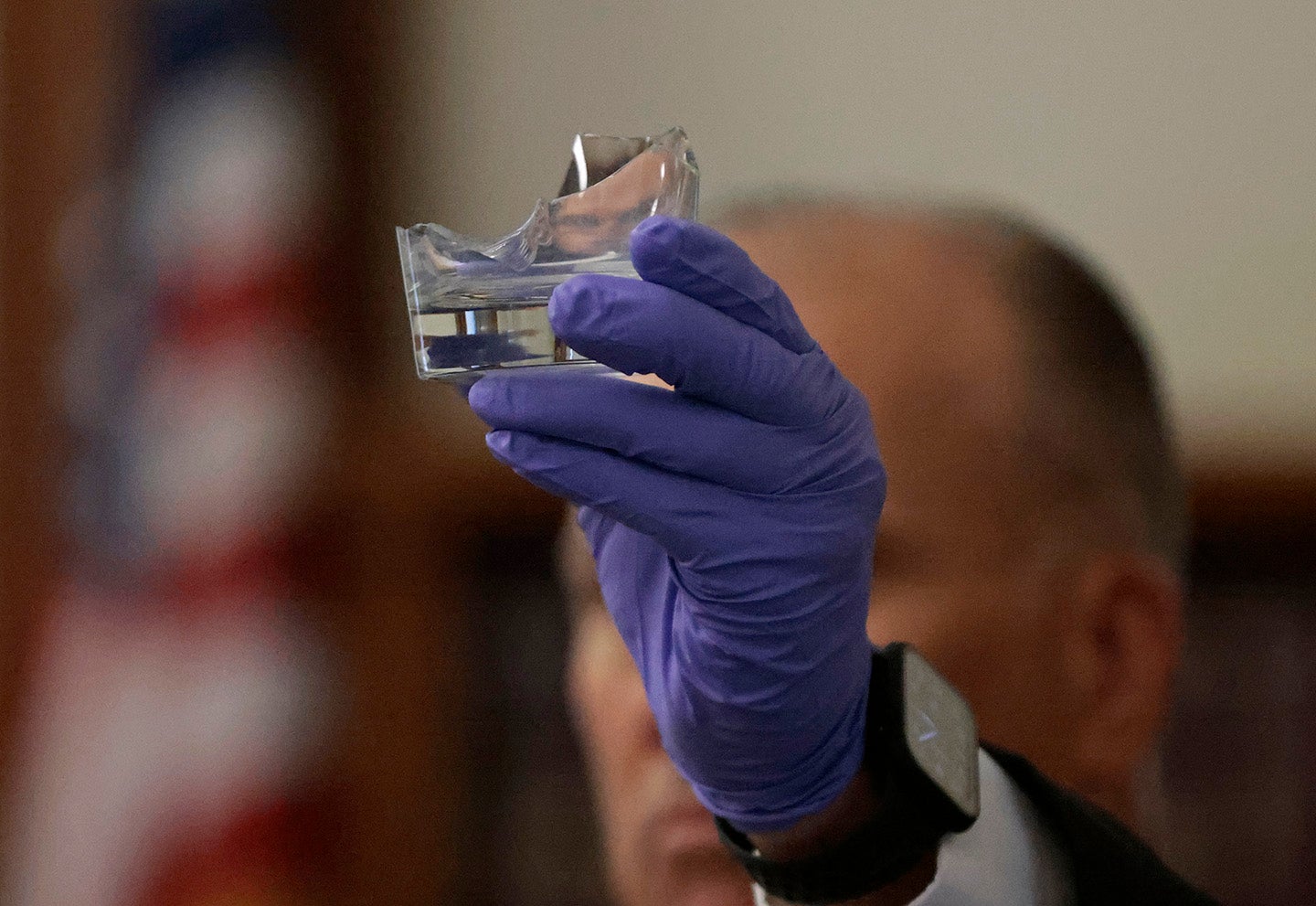
Gallagher said the only visible footprints crossing the front lawn were from Lank. Canton police found a broken cocktail glass in the snow and bagged it as evidence, he told jurors before producing the broken glass for display.
Gallagher also explained that he and then-Police Chief Kenneth Berkowitz discussed recusing the Canton Police Department from the case “because our best detective, his name was Kevin Albert, … was the brother of the homeowner. And I didn’t want any potential bias — whether unconscious or subjective — to be perceived by the … O’Keefe family.”
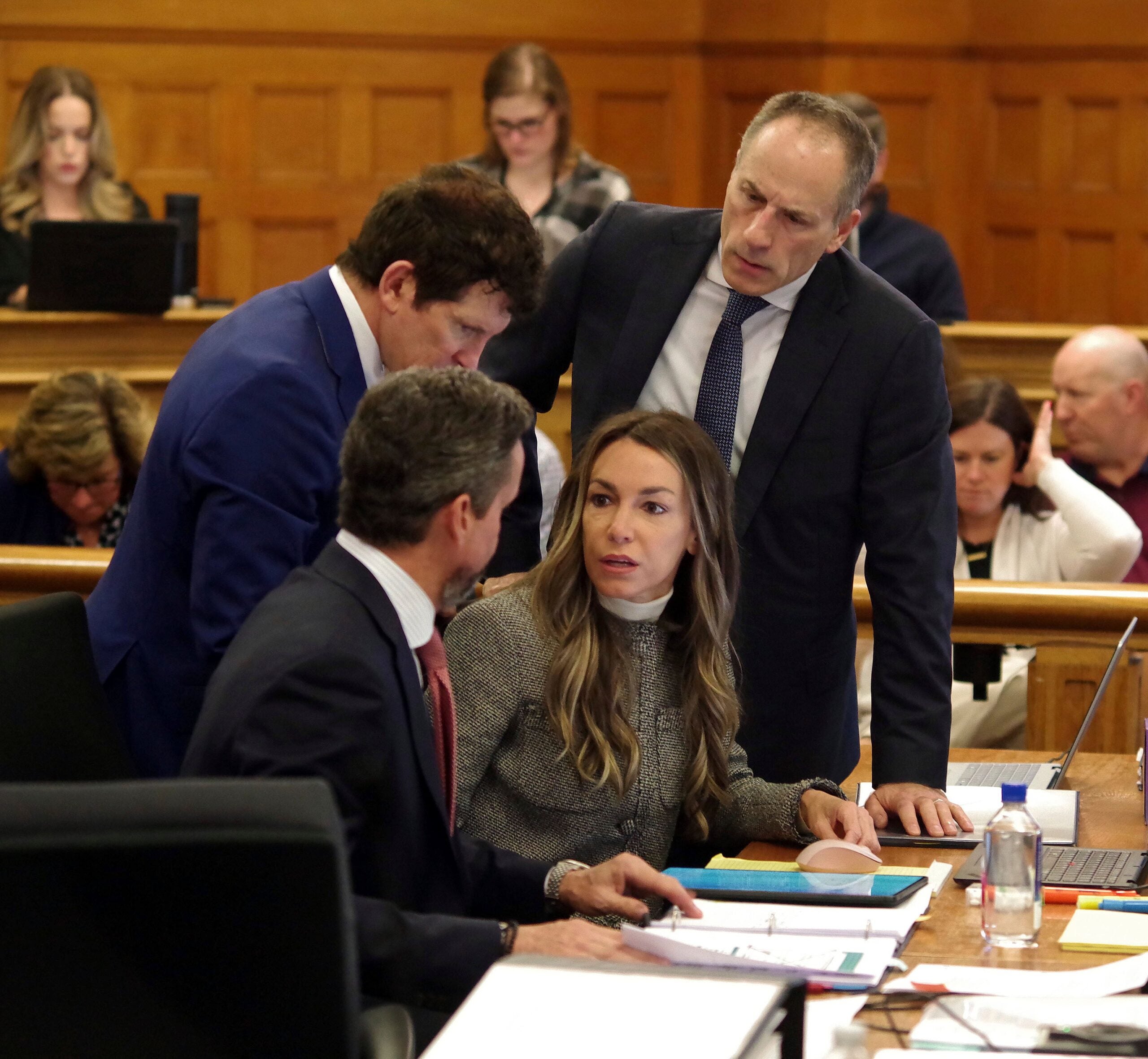
As he began his cross-examination, defense attorney Alan Jackson took Gallagher to task over his lack of formal reports memorializing what he did or observed at the scene on Jan. 29. Gallagher noted other officers present at the scene wrote reports.
Jackson also asked what Canton police did to preserve the scene for later investigation, and Gallagher explained “there were no civilians to trample through” the area. Once paramedics were gone, he said, police put up crime scene tape, took photographs, and collected evidence.
As for the six Solo cups containing blood samples, Gallagher testified earlier Monday that Canton police investigators used a paper grocery bag from Stop & Shop to transport the cups back to the police station. He said he wasn’t sure where the bag came from, but that it was the same size and material as the evidence bags police use.
“You also know that Canton PD has evidence collection bags at Canton PD?” Jackson asked, and Gallagher said he did.
“You also know that they have materials and tools to gather biological material, correct?” Jackson pressed.
“We do have swabs, yes,” Gallagher answered.
Jackson prodded Gallagher’s decision not to send an officer back to the police station for proper evidence collection materials, and Gallagher argued the 15 minutes it might have taken “would have made a difference.” Jackson pointed out Gallagher did send Goode for a leaf blower, and Gallagher noted police used that time to document the scene.
“You could have documented the scene with photographs even if you went back and got a swab,” Jackson shot back. “What’s the difference?”
“It was ongoing,” Gallagher said. “I needed the other officers. We talked about scene security. I already let one officer go — I now have three left. We’re securing that scene.”
Gallagher also said he and Lank were the only two officers who would have had access to the area where the Canton Police Department kept the swabs in question.
Jackson then grilled Gallagher about investigators’ decision to use Solo cups for makeshift evidence collection containers.
“The same kind of Solo cups that we all see at backyard barbecues?” he asked.
“Yep, they hold liquid terrifically,” Gallagher testified.
“They’re also not sealed, correct?” Jackson prompted.
“They are not,” Gallagher confirmed.
“They’re also not used normally … for evidence collection, correct?” Jackson pressed.
“Oh, absolutely not,” Gallagher agreed.
Answering a question from Jackson about possible contamination, Gallagher stated: “DNA is pretty hardy, pretty forensically stable. The only things that are going to harm it are radiation, ultraviolet light, harsh chemicals such as bleach. That’s not present here.”
What if the contamination were from other DNA, Jackson asked.
“Then you would have two sets of DNA when it’s tested, which would benefit you,” Gallagher shot back.
“Well, depends on whose DNA it is,” Jackson argued.
“That’s correct,” Gallagher conceded. “That’s correct.”
Jackson also pointed out Canton police didn’t photograph or document exactly where they collected the blood samples, meaning they don’t know where each cup’s contents came from specifically. Gallagher further confirmed the Stop & Shop bag was folded over and not forensically sealed.
Judge Beverly Cannone dismissed jurors for the day around 4 p.m. Gallagher will return to the stand Tuesday morning for additional questioning.
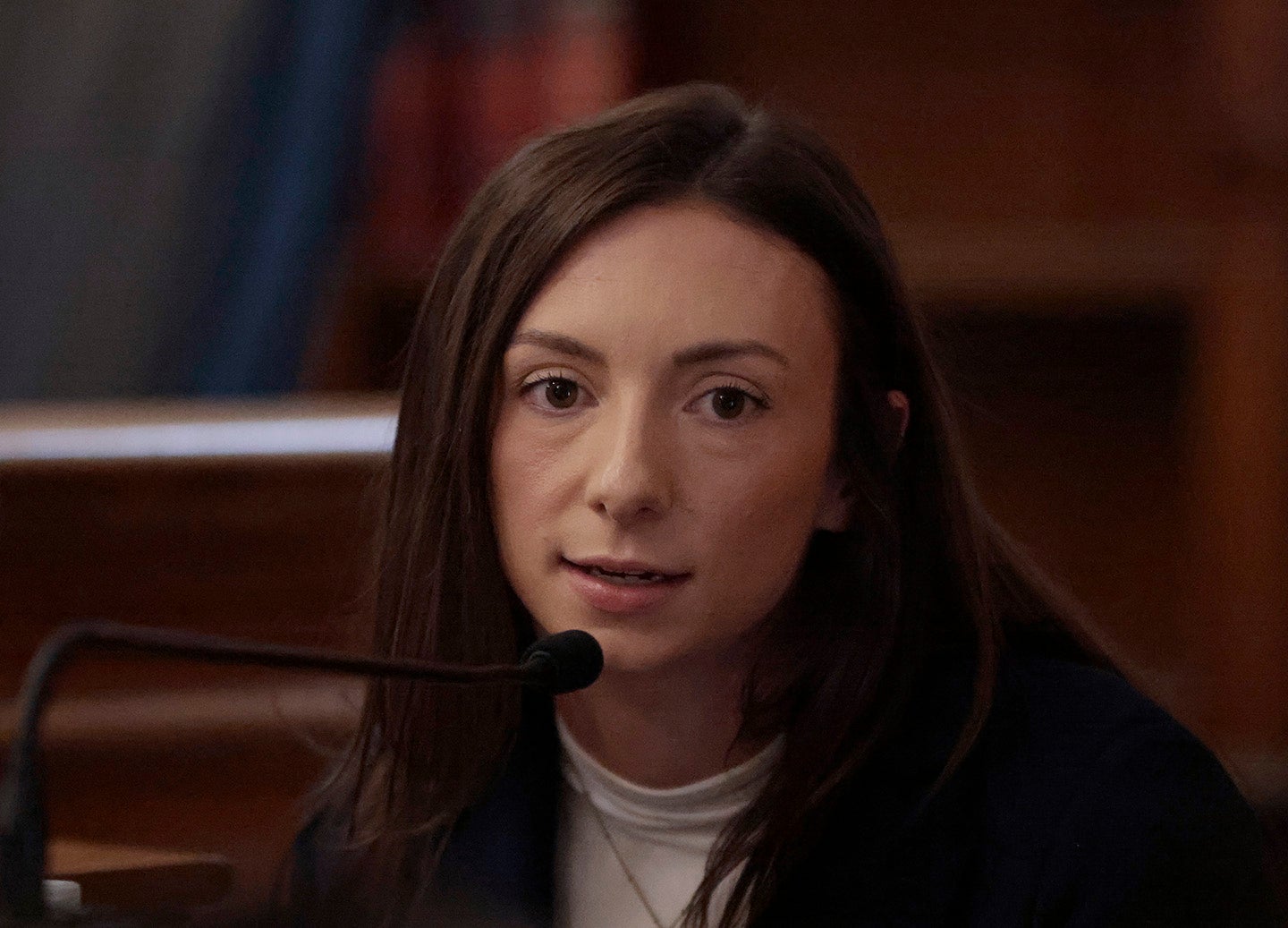
Frantic and “distraught” after finding John O’Keefe unresponsive in the snow, Karen Read repeatedly told first responders “I hit him,” Canton firefighter and paramedic Katie McLaughlin testified Monday.
McLaughlin said she was working an assigned shift the morning of Jan. 29, 2022, when she was called to 34 Fairview Road for a report of “a man unresponsive in the snow.”
While her colleagues worked on O’Keefe at the scene, McLaughlin said she tried to get more information from a woman who “seemed to be really concerned and involved with the patient’s status.” She identified that person as Read and said the defendant was able to provide O’Keefe’s name, birthday, and some basic medical history.
“I asked if there had been any significant trauma that happened that preceded this, and she answered with a series of statements that she repeated: ‘I hit him. I hit him,’” McLaughlin recalled. She testified that another woman standing nearby told Read to calm down and said she later learned that woman was Jennifer McCabe.
According to McLaughlin, Read repeated “I hit him” within earshot of a police officer, who then signalled for his sergeant to come to 34 Fairview Road. Special prosecutor Hank Brennan asked McLaughlin whether she persisted in trying to clarify what Read meant, but she said she didn’t in light of the “disturbing” and “emotional” situation.
“The woman was very upset. I didn’t feel comfortable pushing and asking for more,” McLaughlin testified. “I just didn’t think that it was the right time for that, and it was also really not my place at that point. And I feel like that was something that the police were — that’s more their role.”
Jurors also viewed dashboard camera footage from a police cruiser showing McLaughlin talking with Read and McCabe at the scene, though the audio was unintelligible.
Answering questions from Brennan, McLaughlin testified she went to high school with Caitlin Albert, the daughter of the couple who owned 34 Fairview Road at the time. She told jurors she and Caitlin Albert have mutual friends and would see each other in group settings and socialize occasionally.
“I don’t have a personal relationship with her. I wouldn’t consider her to be a friend of mine, but I do see her occasionally because of social events,” McLaughlin explained.
On cross-examination, defense attorney Alan Jackon asked McLaughlin who she spoke to in anticipation of her testimony Monday, and she replied she met with Brennan, a witness advocate, and various Massachusetts State Police troopers on three occasions. She confirmed Brennan told her he would ask about her relationship with Caitlin Albert.
McLaughlin also testified that she first informed prosecutors of her relationship with Albert after “there started to be a lot of harassment and … insinuations and stuff that started coming out online.”
Jackson pressed McLaughlin on her testimony about Caitlin Albert during Read’s first trial, and she confirmed she previously testified she “went to high school with somebody named Caitlin Albert.”
“Ms. McLaughlin, that was not a full and accurate statement of your relationship with Caitlin Albert, correct?” Jackson asked.
“I mean, that’s a fact,” McLaughlin replied. She testified she and Albert have attended group outings and events together, adding, “We’ve known each other for years, but we are not close friends.”
“The reality is, Ms. McLaughlin, your relationship with Caitlin Albert is far more than simply somebody that you went to high school with, isn’t that true?” Jackson asked.
McLaughlin stood by her previous testimony, telling jurors, “I described what it is.”
Jackson turned his attention to McLaughlin’s initial interview with State Police troopers, asking if Canton Police Detective Kevin Albert — homeowner Brian Albert’s brother — arranged the interview. McLaughlin testified she’s never spoken with Kevin Albert.
She told jurors she heard Read say “I hit him” a total of four times, and Jackson asked McLaughlin whether she heard Read ask, “Could I have hit him? Did I hit him?” However, she maintained she didn’t hear those questions or anything similar.
Jackson also questioned whether McLaughlin saw police handcuff Read in light of her purported “confession,” and McLaughlin said she did not.
McLaughlin testified she wrote down O’Keefe’s basic demographic information on her latex glove as she spoke with Read at the scene. While she didn’t write down Read’s alleged “I hit him” statement, McLaughlin said she intended to relay it to other first responders.
On redirect examination, Brennan asked McLaughlin how she could remember Read’s comments without writing them down.
“I won’t ever forget those statements,” McLaughlin replied.
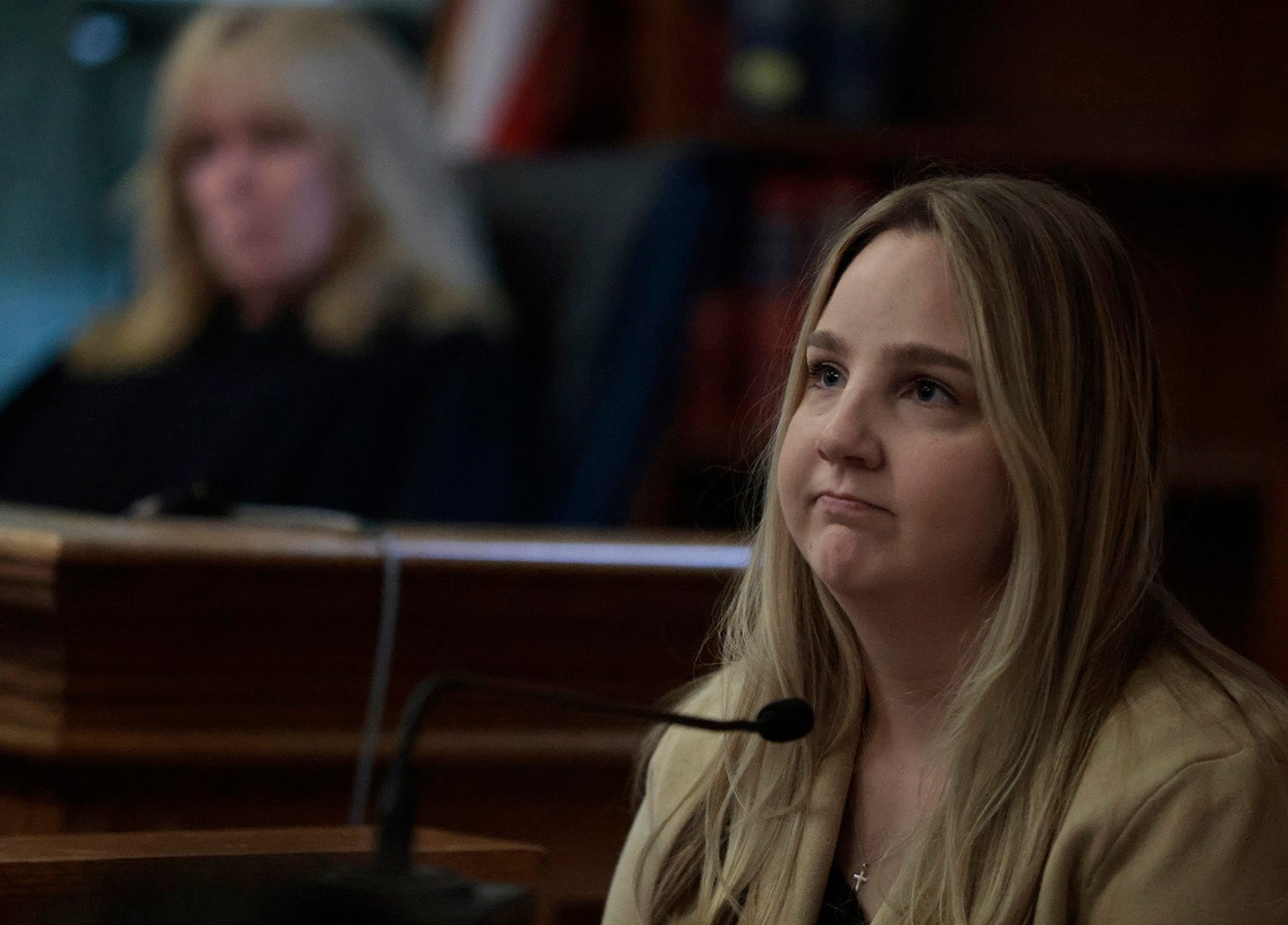
The mood inside 34 Fairview Road was light as Brian Albert Jr. celebrated his birthday at home early into the morning of Jan. 29, 2022, high school friend Sarah Levinson testified.
Levinson described a quiet but festive evening spent with friends. She testified that Albert’s cousin, Colin Albert, arrived at one point and stayed at the party for about 30 to 45 minutes.
“Did the mood change at all in the house?” special prosecutor Hank Brennan asked. Levinson testified it didn’t.
Karen Read’s attorneys previously tried to implicate Colin Albert in their third-party culprit defense, alleging he had “bad blood” with John O’Keefe and could have played a role in O’Keefe’s death. Ahead of Read’s retrial, however, Judge Beverly Cannone ruled the defense can’t try to pin O’Keefe’s death on Colin Albert, as “the evidence of opportunity is wholly inadequate.”
Levinson said a group of adults later turned up at 34 Fairview Road, including Brian Albert Jr.’s parents — Nicole and Brian Sr. — and his sister Caitlin, aunt and uncle Jennifer and Matthew McCabe, and Brian Albert Sr.’s friend Brian Higgins. Levinson denied witnessing any arguing or fighting inside the home.
“Anything extraordinary or remarkable happen inside that house?” Brennan asked.
“No,” Levinson replied.
She said her friend Julie Nagel had arranged for her brother, Ryan, to give her and Levinson a ride home. According to Levinson, Julie Nagel exited the house to speak with her brother when he arrived after midnight on the 29th, though she and Levinson ultimately decided to stay after the McCabes offered them a ride.
After Julie Nagel reentered 34 Fairview Road, no one else came into the house, Levinson said. She estimated she and Nagel left with the McCabes between 1:30 a.m. and 2 a.m. on the 29th and said it was snowing when they left.
“I was wearing shoes that didn’t really have traction, so I was looking at my feet so I didn’t slip,” Levinson testified.
As they drove past 34 Fairview Road, Levinson said she was using her cellphone and heard Nagel say something, though she didn’t specify what she heard.
Brennan asked Levinson if she looked out the window to the front lawn, and she testified she looked up as they passed a cluster of trees at the edge of the property, though she didn’t notice anything that stood out.
On cross-examination, defense attorney Alan Jackson asked Levinson whether she remembered testifying during Read’s trial last year that she hadn’t met the Alberts’ dog, Chloe.
“If that’s what it says I said, then yes,” Levinson replied. Answering a follow-up question from Jackson, she said she didn’t know why she hadn’t met the dog during previous visits to 34 Fairview Road.
Jackson later asked Levinson whether she had spoken about the case with Nagel before she was first interviewed by police in October 2022.
“Somewhat,” Levinson responded.
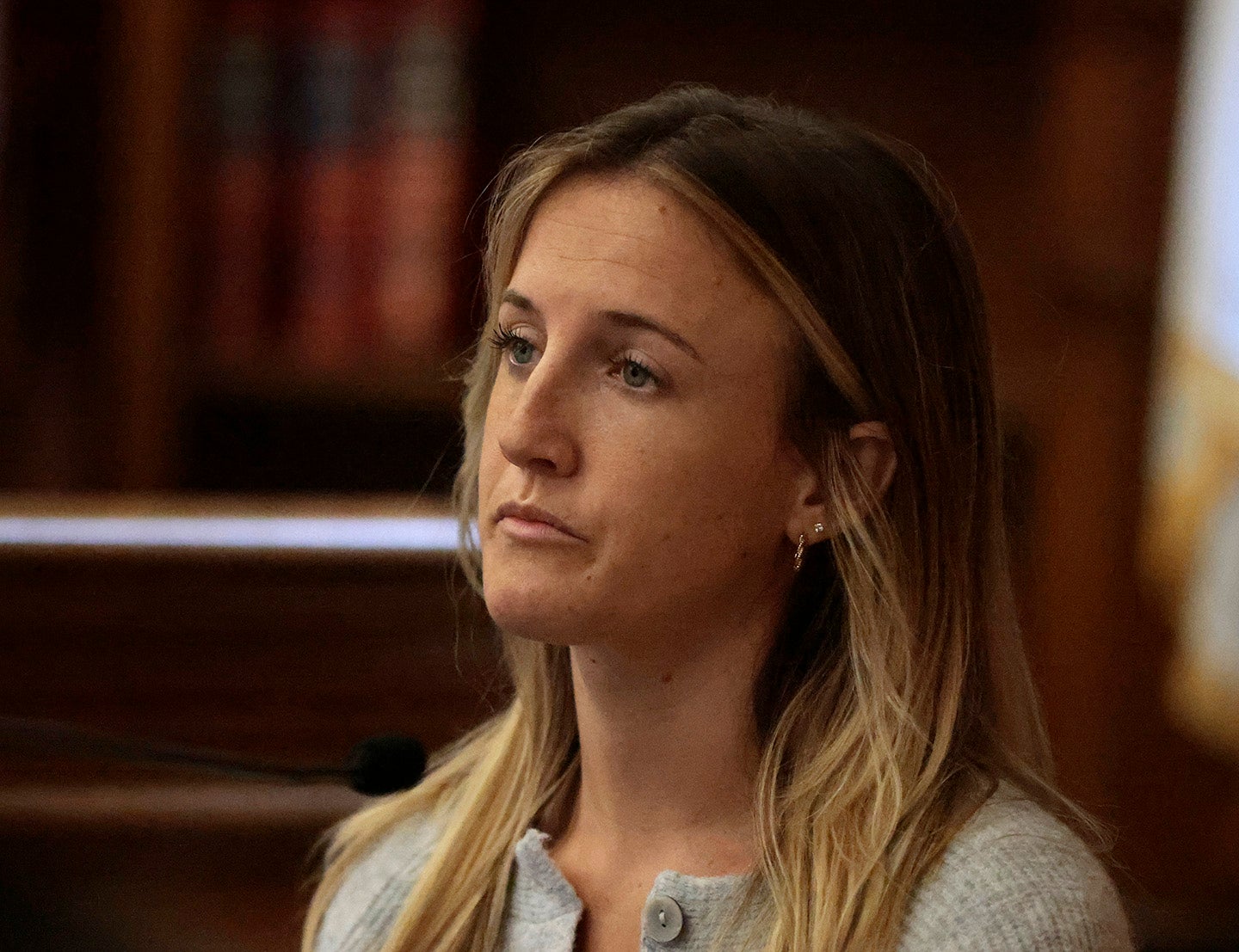
Accompanying her then-boyfriend Ryan Nagel to 34 Fairview Road after midnight on Jan. 29, 2022, Heather Maxon testified she saw a couple inside an SUV that turned onto Fairview around the same time.
Maxon said she didn’t recognize the woman who was driving the SUV or the man sitting in the passenger seat. She testified that she had gone drinking with Nagel and others earlier that night and said the alcohol “most likely” affected her perception and memory.
Answering special prosecutor Hank Brennan’s questions, Maxon said she didn’t notice anything about the SUV’s taillights, including whether they were broken. She denied seeing anyone get out of the SUV or cross the front yard to the home.
Nagel’s friend Richard D’Antuono had driven them to 34 Fairview Road to give Nagel’s sister, Julie, a ride home from a party. But Julie Nagel ultimately decided to stay at the party a little longer, so D’Antuono drove off.
Maxon testified that as D’Antuono pulled away and passed the SUV, she saw a woman in the driver’s seat with the car’s dome light illuminated. She said she didn’t see anyone else inside the SUV, nor did she see anyone standing outside the car or lying on the front lawn.
Defense attorney David Yannetti asked Maxon if she could remember using her cellphone while waiting for Julie Nagel to exit the house. Maxon testified she couldn’t say for certain whether she had.
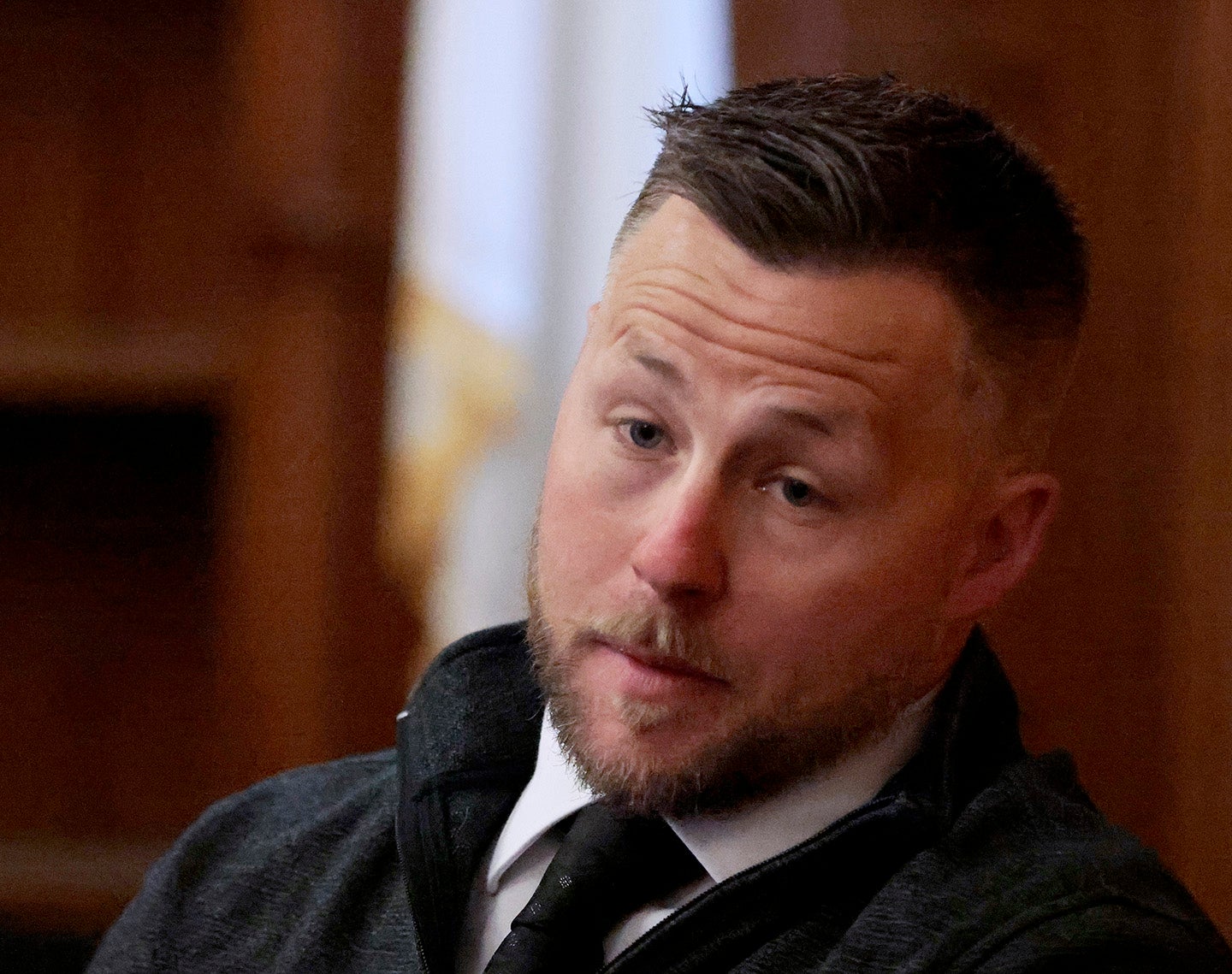
As he and his friends drove past 34 Fairview Road after midnight on Jan. 29, 2022, Ryan Nagel testified he saw a woman sitting outside the home in a black SUV, her hands on the steering wheel and the car’s interior dome light illuminated.
Nagel testified he’d gone out for drinks that night with his friends, and special prosecutor Hank Brennan asked Nagel if the alcohol had impaired him.
“I wouldn’t say impaired,” Nagel replied. “I only drank beer.”
He said his friend Richard D’Antuono then drove Nagel and his then-girlfriend, Heather Maxon, over to Fairview Road sometime after midnight to give Nagel’s sister, Julie, a ride home.
As D’Antuono’s truck approached Fairview Road, Nagel said he saw another vehicle heading in their direction. The other car, a black SUV, used its turn signal and turned right onto Fairview, he said. Nagel estimated he and his friends arrived at 34 Fairview Road a little before 12:30 a.m. and said the black SUV was pulled ahead of them.
He said Julie Nagel exited the home and invited her brother and his friends inside for a drink, but they declined. Julie Nagel went back inside, and D’Antuono drove away.
Ryan Nagel said he was focused on making sure his sister got back inside, but he saw a woman in the driver’s seat of the black SUV as D’Antuono drove past. Nagel said he didn’t see anyone else in the car, though he wasn’t actively looking for anyone. Answering a question from Brennan, he said there could have been someone standing outside the car’s door.
Nagel also denied seeing anyone get out of the SUV and walk toward the driveway or cross the front yard to the home and enter through the front or side doors. He also testified that he didn’t see anyone lying on the ground near a flagpole outside the home.
He said snow was just starting to fall as he and his friends left Fairview Road, and the bare ground was still visible. Nagel further testified that he didn’t notice any pieces missing from the black SUV, as he “wasn’t observing the vehicle like that.” The car’s taillights appeared red, he testified.
On cross-examination, defense attorney David Yannetti focused on Nagel’s brief conversation with his sister. Nagel said he spoke with his sister for about two or three minutes outside 34 Fairview Road and confirmed his sister appeared to have been drinking.
“You have testified in the past that Julie can be kind of a pain in the ass, correct?” Yannetti asked.
“I mean, all siblings can be, yeah,” Nagel replied.
Answering another question from Yannetti, Nagel said the woman he saw in the driver’s seat of the black SUV was facing straight ahead. He also confirmed he did not see a man in the car’s passenger seat.
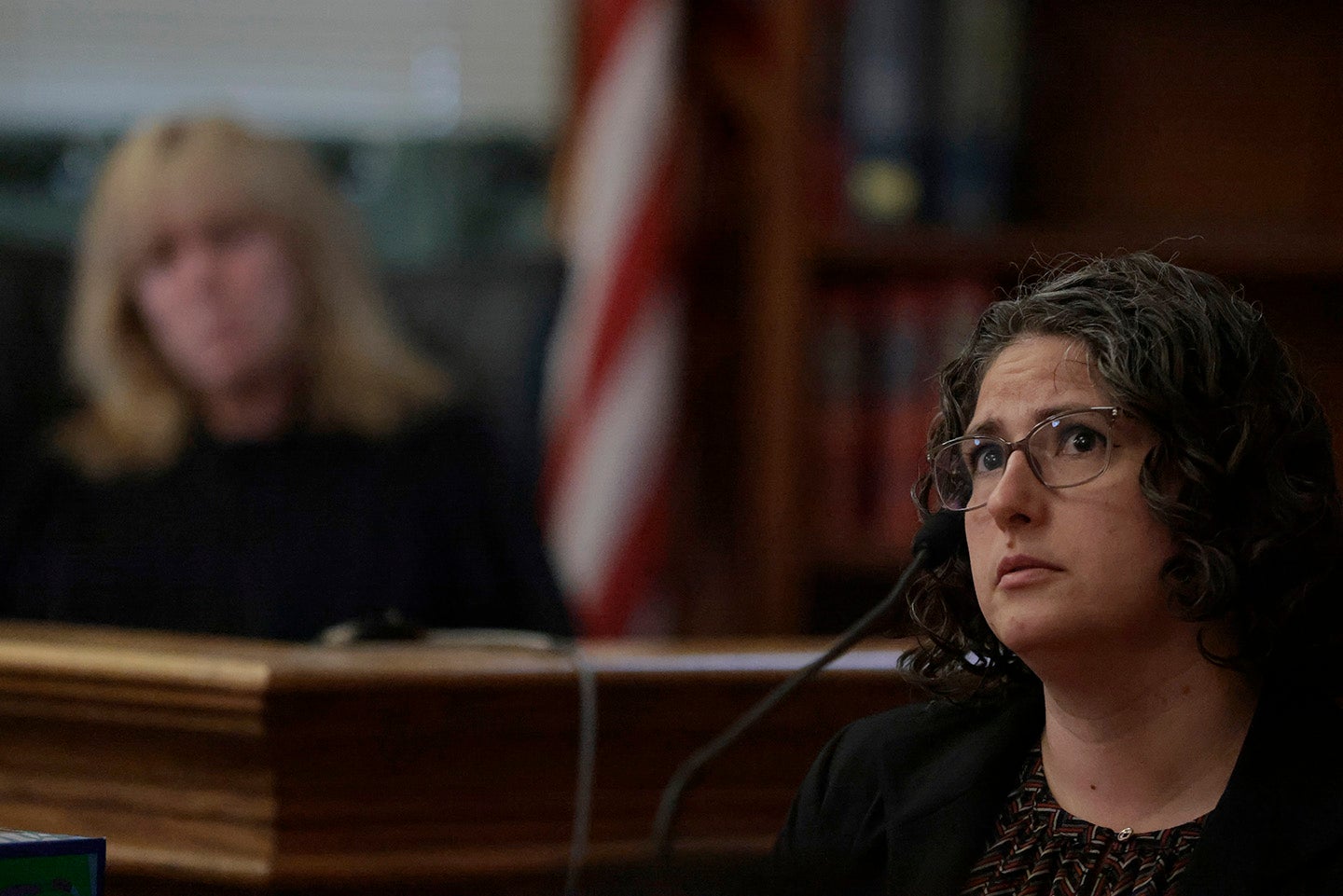
Hannah Knowles, a forensic scientist from the Massachusetts State Police Crime Lab, was back on the stand Monday morning as defense attorney David Yannetti prodded her analysis of Karen Read’s blood alcohol test.
Knowles previously testified Friday that her retrograde analysis put Read’s blood alcohol level between 0.14% and 0.28% at 12:45 a.m. on Jan. 29, 2022, around the time prosecutors allege Read backed her SUV into John O’Keefe.
Knowles told jurors she based her calculations on Read’s lab work at Good Samaritan Medical Center from around 9 a.m. on Jan. 29. Dr. Garrey Faller, the hospital’s former laboratory medical director, testified earlier that Read registered an alcohol level of 93 mg/dl in her serum, the liquid portion of blood.
According to Knowles, Read’s blood alcohol level was between 0.078% and 0.092% when she had her blood tested just after 9 a.m. The legal limit for driving is 0.08%.
Answering Yannetti’s questions, Knowles confirmed she has no knowledge of Good Samaritan’s policies and procedures for drawing blood and can’t vouch for the tubes and vials the hospital uses. Yannetti asked Knowles if she was aware there had been a recall on certain tubes and vials due to an issue with contamination, but Judge Beverly Cannone sustained an objection from prosecutors before Knowles could answer.
Knowles also testified she does not know whether the test results from Good Samaritan were the result of confirmatory testing.
“And you cannot testify that the testing done at Good Samaritan meets your accreditation standards, correct?” Yannetti asked.
“Correct,” Knowles replied.
Yannetti asked about factors that could affect someone’s blood alcohol test results. He pressed Knowles about whether her “serum conversion” resulted in a precise number, and Knowles testified her calculations provided a range.
Answering a question from Yannetti, she said if Read had continued to drink after 12:45 a.m., “the foundation of my calculations would be incorrect” and would need to factor in that additional information.
Assistant District Attorney Adam Lally asked Knowles about the potential impact to her calculations if Read had had a drink at about 1 a.m. on Jan. 29. Knowles said it would depend on how much liquor Read consumed. Answering a subsequent question from Lally, she said the range forensic scientists give in calculating blood alcohol concentrations is intentionally wide to account for unknown factors and diversity in the general population.
Livestream via NBC10 Boston.
Karen Read’s murder retrial returns for a full day of testimony Monday following a fiery week in court that saw key witness Jennifer McCabe take the stand.
Defense attorney Alan Jackson had McCabe in the hot seat for cross-examination, a tense back-and-forth that resulted in pointed jabs and at times even raised voices.
Prosecutors allege Read, 45, backed her SUV into her boyfriend, Boston Police Officer John O’Keefe, in a drunken rage while dropping him off at an afterparty in Canton following a night of bar-hopping. McCabe, whose sister and brother-in-law owned the home in question, was with Read and another woman when they found O’Keefe unresponsive in the snow on Jan. 29, 2022.
McCabe testified that she could remember “with 100% accuracy” that Read made damning comments to first responders shortly after finding O’Keefe.
“‘I hit him, I hit him, I hit him,’” McCabe recalled. “It’s just as fresh today as it was three years ago.”
However, Read’s lawyers contend she was framed in a vast coverup among law enforcement and afterparty guests, McCabe included. They’ve floated an alternate theory that O’Keefe was attacked after entering 34 Fairview Road and ultimately dumped outside in a blizzard.
One of the most contentious pieces of evidence in the case is McCabe’s “hos long to die in cold” Google search, which the defense alleges she made at 2:27 a.m. on Jan. 29 — hours before O’Keefe turned up in the snow.
On the stand last week, McCabe was adamant she made the search after finding O’Keefe, and at Read’s insistence. Cellebrite digital forensics expert Ian Whiffin previously testified that McCabe’s phone data shows searches for “how long ti die in cikd” and “hos long to die in cold” at 6:23 a.m. and 6:24 a.m., respectively. He explained the 2:27 a.m. timestamp offered by the defense actually indicates when McCabe opened the Safari tab she used for the search.
McCabe also denied deleting the “hos long” search from her phone, and Whiffin likewise seemed skeptical she could have done so.
At various points in his cross-examination, Jackson accused McCabe of colluding and coordinating information with other witnesses in the case — allegations she adamantly denied.
She also denied lying to law enforcement in connection with Read’s case, though she acknowledged she was less than forthcoming in a 2023 interview with agents from an unspecified law enforcement agency. McCabe denied lying to the agents, saying she had simply “forgotten” to tell them about some of the people she contacted before she sat down for the initial interview. She also pointed out that she ultimately met with the agents several times and helped “clear up” some of their misconceptions about the case.
Friday’s court proceedings left off with testimony from Hannah Knowles, a forensic scientist from the Massachusetts State Police Crime Lab who testified that a retrograde analysis put Read’s blood alcohol level between 0.14% and 0.28% at 12:45 a.m. on Jan. 29.

Sign up for our Extra newsletter to get updates from the retrial and other breaking news alerts delivered to your inbox.




To comment, please create a screen name in your profile
To comment, please verify your email address
Conversation
This discussion has ended. Please join elsewhere on Boston.com